1.Rotary
telephone(1892)
 A rotary dial is a component of a telephone or a telephone switchboard that implements a signaling technology in telecommunications known as pulse dialing. It is used when initiating a telephone call to transmit the destination telephone number to a telephone exchange.
On the rotary dial, the digits are arranged in a circular layout so that a finger wheel may be rotated with one finger from the position of each digit to a fixed stop position, implemented by the finger stop, which is a mechanical barrier to prevent further rotation. When released at the finger stop, the wheel returns to its home position by spring action at a speed regulated by a governor device. During this return rotation, the dial interrupts the direct electrical current of the telephone line (local loop) a specific number of times for each digit and thereby generates electrical pulses which the telephone exchange decodes into each dialed digit. Each of the ten digits are encoded in sequences of up to ten pulses. For this reason, the method is sometimes called decadic dialling.
The first patent for a rotary dial is due to Almon Brown Strowger (November 29, 1892) as U.S. Patent 486,909, but the commonly known form with holes in the finger wheel was not introduced until ca. 1904. While used in telephone systems of the independent telephone companies, rotary dial service in the Bell System in the United States was not common until the introduction of the Western Electric model 50AL in 1919.
From the 1960s onward, the rotary dial was gradually supplanted by dual-tone multi-frequency push-button dialing, first introduced to the public at the 1962 World's Fair under the trade name "Touch-Tone". Touch-tone technology primarily used a keypad in form of a rectangular array of push-buttons for dialing.
A rotary dial is a component of a telephone or a telephone switchboard that implements a signaling technology in telecommunications known as pulse dialing. It is used when initiating a telephone call to transmit the destination telephone number to a telephone exchange.
On the rotary dial, the digits are arranged in a circular layout so that a finger wheel may be rotated with one finger from the position of each digit to a fixed stop position, implemented by the finger stop, which is a mechanical barrier to prevent further rotation. When released at the finger stop, the wheel returns to its home position by spring action at a speed regulated by a governor device. During this return rotation, the dial interrupts the direct electrical current of the telephone line (local loop) a specific number of times for each digit and thereby generates electrical pulses which the telephone exchange decodes into each dialed digit. Each of the ten digits are encoded in sequences of up to ten pulses. For this reason, the method is sometimes called decadic dialling.
The first patent for a rotary dial is due to Almon Brown Strowger (November 29, 1892) as U.S. Patent 486,909, but the commonly known form with holes in the finger wheel was not introduced until ca. 1904. While used in telephone systems of the independent telephone companies, rotary dial service in the Bell System in the United States was not common until the introduction of the Western Electric model 50AL in 1919.
From the 1960s onward, the rotary dial was gradually supplanted by dual-tone multi-frequency push-button dialing, first introduced to the public at the 1962 World's Fair under the trade name "Touch-Tone". Touch-tone technology primarily used a keypad in form of a rectangular array of push-buttons for dialing.
2.Super 8mm film(1965)
 Super 8mm film is a motion picture film format released in 1965 by Eastman Kodak as an improvement of the older "Double" or "Regular" 8 mm home movie format.
The film is nominally 8 mm wide, the same as older formatted 8mm film, but the dimensions of the rectangular perforations along one edge are smaller, which allows for greater exposed area. The Super 8 standard also allocates the border opposite the perforations for an oxide stripe upon which sound can be magnetically recorded.
Unlike Super 35, the film stock used for Super 8 is not compatible with standard 8mm film cameras.
There are several different varieties of the film system used for shooting, but the final film in each case has the same dimensions. By far, the most popular system was the Kodak system.
Super 8mm film is a motion picture film format released in 1965 by Eastman Kodak as an improvement of the older "Double" or "Regular" 8 mm home movie format.
The film is nominally 8 mm wide, the same as older formatted 8mm film, but the dimensions of the rectangular perforations along one edge are smaller, which allows for greater exposed area. The Super 8 standard also allocates the border opposite the perforations for an oxide stripe upon which sound can be magnetically recorded.
Unlike Super 35, the film stock used for Super 8 is not compatible with standard 8mm film cameras.
There are several different varieties of the film system used for shooting, but the final film in each case has the same dimensions. By far, the most popular system was the Kodak system.
2.Super 8mm film(1965)
3.Microcassette(1969)
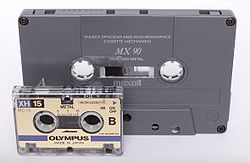
A Microcassette (often written generically as microcassette) is an audio storage medium introduced by Olympus in 1969. It uses the same width of magnetic tape as the Compact Cassette but in a much smaller container. By using thinner tape and half or a quarter the tape speed, microcassettes can offer comparable recording time to the compact cassette. The original standard microcassette, the MC60, gives 30 minutes recording per side at its standard speed of 2.4 cm/s, and double that duration at 1.2 cm/s; an MC90, giving 45 minutes per side @ 2.4 cm/s, is also available from a few manufacturers. Unlike the Compact Cassette, a choice of recording speeds was provided on the original recorders and many others; the tape also spools in the opposite direction, from right to left. For transcription purposes, continuously variable speed was provided on many players.
4.4.5” Floppy disk(1971)

A floppy disk, also called a floppy, diskette or just disk, is a type of disk storage composed of a disk of thin and flexible magnetic storage medium, sealed in a rectangular plastic enclosure lined with fabric that removes dust particles. Floppy disks are read and written by a floppy disk drive.
Floppy disks, initially as 8-inch (200 mm) media and later in 5¼-inch (133 mm) and 3½-inch (90 mm) sizes, were a ubiquitous form of data storage and exchange from the mid-1970s into the late 2000s.
By 2007, computers were rarely manufactured with installed floppy disk drives; 3½-inch floppy disks can be used with an external USB floppy disk drive, but USB drives for 5¼-inch, 8-inch, and non-standard diskettes are rare to non-existent. These formats are usually handled by older equipment.
While floppy disk drives still have some limited uses, especially with legacy industrial computer equipment, they have been superseded by data storage methods with much greater capacity, such as USB flash drives, flash storage cards, portable external hard disk drives, optical discs, ROM cartridges and storage available through computer networks.
5.Jog-dial VCR remote(1973)

In consumer electronics, a remote control is a component of an electronic device such as a television set, DVD player, or other home appliance, used to operate the device wirelessly from a short distance. Remote control is a convenience feature for the consumer, and can allow operation of devices that are out of convenient reach for direct operation of controls.
Commonly, remote controls are Consumer IR devices which sends digitally-coded pulses of infrared radiation to control functions such as power, volume, tuning, temperature set point, fan speed, or other features. Remote controls for these devices are usually small wireless handheld objects with an array of buttons for adjusting various settings such as television channel, track number, and volume. For many devices, the remote control contains all the function controls while the controlled device itself has only a handful of essential primary controls.
Earlier remote controls in 1973 used ultrasonic tones. The remote control code, and thus the required remote control device, is usually specific to a product line, but there are universal remotes, which emulate the remote control made for most major brand devices.
Remote control has continually evolved and advanced over recent years to include Bluetooth connectivity, motion sensor-enabled capabilities and voice control
6.Betacam(1982)

Betacam is a family of half-inch professional videocassette products developed by Sony in 1982. In colloquial use, "Betacam" singly is often used to refer to a Betacam camcorder, a Betacam tape, a Betacam video recorder or the format itself.
All Betacam variants from (plain) analog recording Betacam to Betacam SP and digital recording Digital Betacam (and additionally, HDCAM & HDCAM SR), use the same shape videocassettes, meaning vaults and other storage facilities do not have to be changed, when upgrading to a new format. The cassettes are available in two sizes: S (for Short) and L (for Long). The Betacam camcorder can only load S magnetic tapes, while television studio sized video tape recorders designed for video editing can play both S and L tapes.
The cassette shell and case for each Betacam cassette is colored differently depending on the format, allowing for easy visual identification. There is also a mechanical key, that allows a video tape recorder to identify which format has been inserted. The smaller S cassettes use the same form factor as Betamax.
The format supplanted the three-quarter-inch U-Matic format, which Sony had introduced in 1971. In addition to improvements in video quality, the Betacam configuration of an integrated professional video camera/recorder led to its rapid adoption by electronic news gathering organizations.
DigiBeta, the common name for Digital Betacam, went on to become the single most successful professional broadcast digital recording video tape format in history.
Even though Betacam remains popular in the field and for archiving, new tapeless digital products such as the Multi Access Video Disk Recorder are leading to a phasing out of Betacam products in a television studioenvironment, as of 2006.
7.Hi-8 video camera(1985)

To counter the introduction of the Super-VHS format, Sony introduced Video Hi8 (short for high-band Video8). Like S-VHS, Hi8 uses improved recorder electronics and media formulation to increase the recorded bandwidth of the luminance signal. Both Hi8 and S-VHS were officially rated at a luminance resolution of 400 lines, a vast improvement from their respective base formats and are roughly equal to Laserdisc quality. Chroma resolution for both remain unchanged.
Both S-VHS and Hi8 retain the audio recording systems of their base formats; VHS HiFi Stereo outperforms Video8/Hi8 AFM, but remains restricted to high-end machines. In the late 1980s, digital (PCM) audio was introduced into some higher-grade models of Hi8 (but never S-VHS) recorders. Hi8 PCM audio operates at a sampling rate of 32 kHz with 8-bit samples—higher fidelity than the monaural linear dubbing offered by VHS/S-VHS, but vastly inferior to VHS HiFi. PCM-capable Hi8 recorders can simultaneously record PCM stereo in addition to the legacy (analog AFM) stereo audio tracks.
The final upgrade to the Video8 format came in 1998, when Sony introduced XR capability (extended resolution). Video8-XR and Hi8-XR offers a modest 10% improvement in luminance detail. XR equipment replays non-XR recordings well, and XR recordings are fully playable on non-XR equipment, though without the benefits of XR.
All Hi8 equipment can record and play in the legacy Video8 format. The reverse is not usually the case though there are a few late-entry Video8 systems that recognize and play Hi8 recordings.
8.CD-ROM(1985)

A CD-ROM is a pre-pressed optical compact disc which contains data. The name is an acronym which stands for "Compact Disc Read-Only Memory". Computers can read CD-ROMs, but cannot write to CD-ROMs which are not writable or erasable.
From the mid-1990s until the mid-2000s, CD-ROMs were popularly used to distribute software for computers and video game consoles. Some CDs, called enhanced CDs, hold both computer data and audio with the latter capable of being played on a CD player, while data (such as software or digital video) is only usable on a computer (such as ISO 9660 format PC CD-ROMs).
An early CD-ROM format was developed by Sony and Denon, introduced at a Japanese computer show in 1984. It was an extension of Compact Disc Digital Audio, and adapted the format to hold any form of digital data, with a capacity of 540 MiB. The Yellow Book is the technical standard that defines the format of CD-ROMs. One of a set of color-bound books that contain the technical specifications for all CD formats, the Yellow Book, standardized by Sony and Philips in 1988, has a capacity of 650 MiB.
9.Mini Disk(1986)

The MiniDisc (MD) is a magneto-optical disc-based data storage device offering a capacity of 74 minutes and, later, 80 minutes, of digitized audio or 1 gigabyte of Hi-MD data. The Sony brand audio players were on the market from September 1992 until March 2013.
MiniDisc was announced by Sony in September 1992 and released that November for sale in Japan and in December in Europe, Canada, the USA and other countries . The music format was originally based exclusively on ATRAC audio data compression, but the option of linear PCM digital recording was later introduced to attain audio quality comparable to that of a compact disc. MiniDiscs were very popular in Japan but made a limited impact elsewhere.
Sony announced they would cease development of MD devices, with the last of the players sold by March 2013.
10.Dial-up modem(1990)

Dial-up Internet access is a form of Internet access that uses the facilities of the public switched telephone network (PSTN) to establish a connection to an Internet service provider (ISP) by dialing a telephone number on a conventional telephone line. The user's computer or router uses an attached modem to encode and decode information into and from audio frequency signals, respectively.
Dial-up Internet has been around since the 1980s via public providers such as NSFNET-linked universities and was first offered commercially in July 1992 by Sprint. Despite losing ground to broadband since the mid-2000s, dial-up may still be used where other forms are not available or the cost is too high, such as in some rural or remote areas.

沒有留言:
張貼留言